

Materials9 min read
Display Stand Materials: PS, ABS, PET, PP and PMMA Compared
Two stands with the same form live different lives depending on the polymer. A report card on strength, clarity, cost and recyclability for five materials.
Read Article
Key takeaways
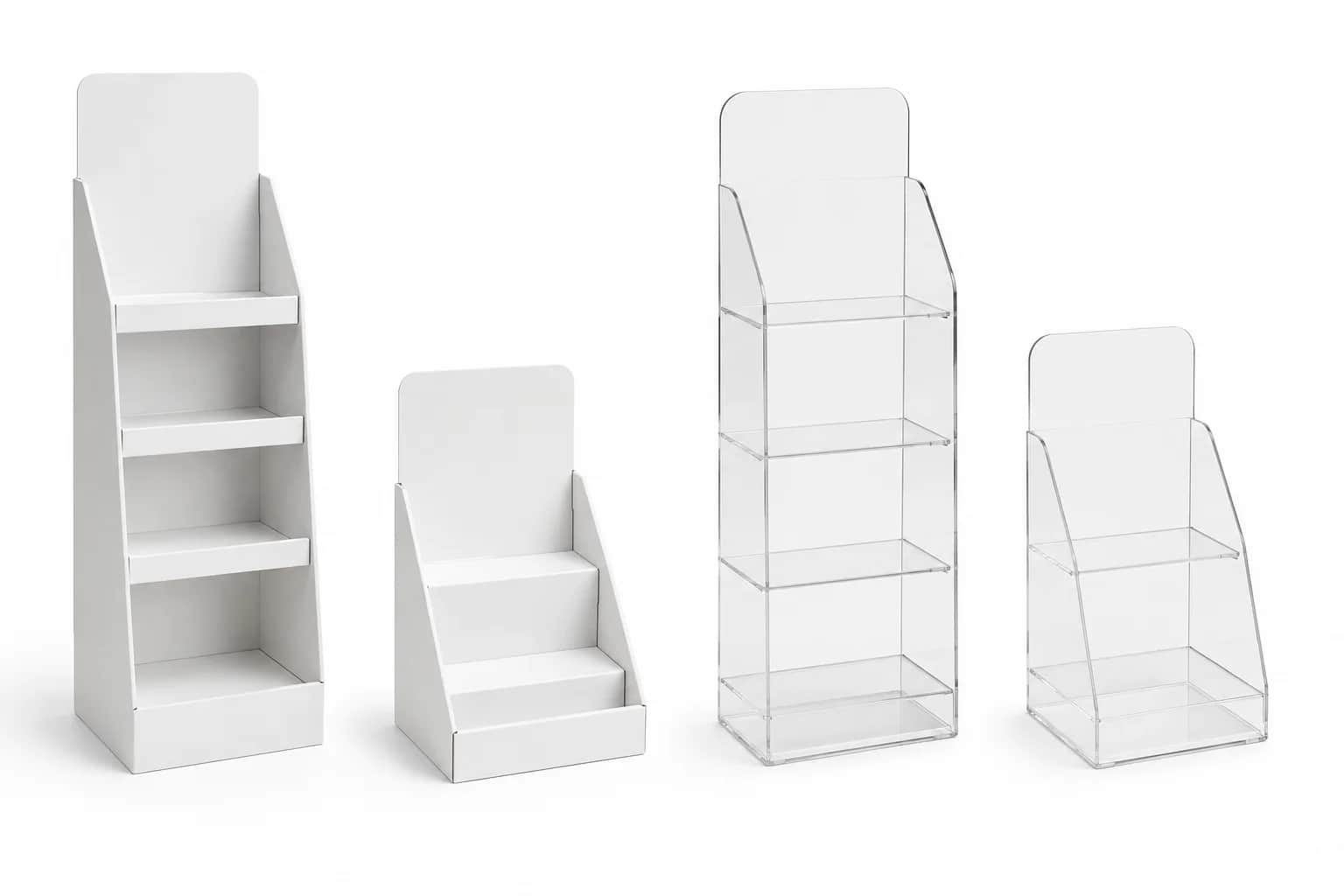
One of the most frequently asked questions in display projects is: cardboard or plastic? There is no single right answer, because the two solve different versions of the same need. A cardboard stand is fast, cheap and temporary. A plastic stand starts slower, demands investment and stays for a long time.
This article compares both options across six headings so the decision does not have to rest on instinct, then summarises clearly which is right in which scenario.
Before entering any material comparison, one question has to be answered: how long will this stand remain in store? Every other variable lines up around that answer.
Cardboard puts its cost in the product; plastic puts it in the tooling. One repeats with every batch, the other is paid once.
The cost structure of a cardboard stand is linear: each new unit costs roughly the same. In a plastic stand most of the cost sits in the mould, and the mould is paid for once. That is why cardboard is economical at low volumes and plastic at high volumes and repeat runs.
The two options build cost from different line items, which makes a direct unit-price comparison misleading.
| Item | Cardboard stand | Plastic stand |
|---|---|---|
| Upfront investment | None or very low (cutting die) | Injection mould — one-off |
| Unit cost | Changes little with volume | Falls markedly as volume grows |
| Repeat production | Same cost every time | Tooling exists, production cost only |
| Lifetime cost | Re-produced for every campaign | Years of use, dressing changed |
The correct comparison is not unit price but total cost of ownership: how many times the stand will be re-produced over the period it is needed. We worked through how tooling cost is spread in our injection mould cost article.
A cardboard stand holds up fine for a few months in dry, low-contact conditions. Store reality, however, is humid, dusty and contact-heavy: shoppers knock it, staff push it, cleaning crews run a wet mop past it. Under those conditions cardboard corners crush, shelves sag and print wears.
A plastic stand stands for years in the same conditions. Its surface can be wiped, it is unaffected by moisture, and under impact — especially in PP — it springs back rather than breaking. For how materials behave, see our display stand materials article.
A cardboard stand’s load capacity comes not from the material but from its structural composition: folded wings, internal support boxes and double-layer shelf bases spread the load. A well-designed cardboard stand carries a surprising amount of weight — but not against time. Once the load becomes constant, the shelf gradually sags.
In a plastic stand, capacity is set by the material’s yield strength and rib structure, and it does not change over time. With heavy products — glass bottles, tins, detergent — that difference becomes decisive.
| Product type | Cardboard stand | Plastic stand |
|---|---|---|
| Light packaging (crisps, confectionery) | Very suitable | Suitable |
| Medium weight (cartons, food pouches) | Suitable | Very suitable |
| Heavy product (glass bottles, tins) | Limited, risk of sagging | Very suitable |
| Liquids and damp environments | Not suitable | Very suitable |
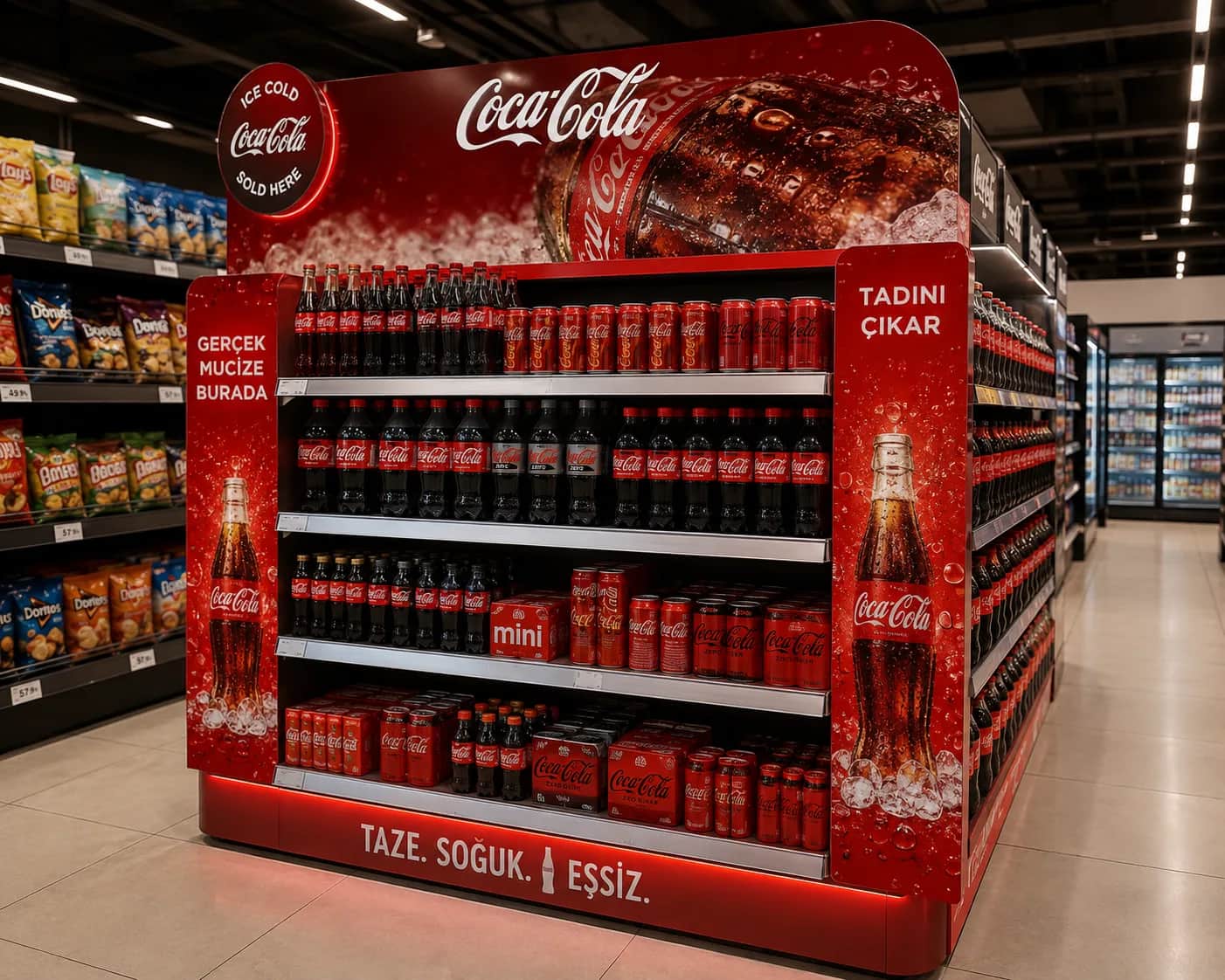
Cardboard holds a clear advantage here. Offset and digital printing can carry photographic, unlimited-colour imagery across the entire surface. Wrapping a whole campaign visual around a stand is natural in cardboard and costly in plastic.
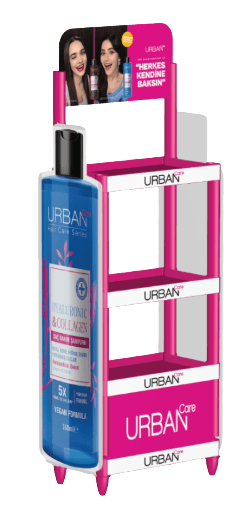
In plastic, print areas are generally more limited and the method changes with volume: screen printing is economical at high volumes, digital UV printing at low ones. In exchange, print on plastic is far more durable — and with coloured raw material, colour survives even scratching.
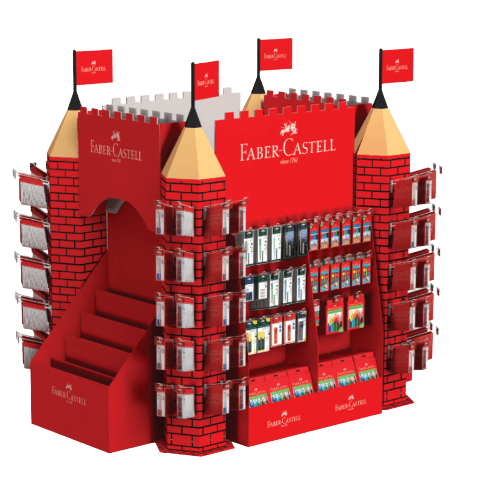
Cardboard stands pack flat and take very little volume, a clear advantage in freight cost. Assembly usually needs no tools and is completed in minutes with folding and slotted parts.
Plastic stands are heavier and take more volume even when shipped flat. In exchange they can be dismantled and moved after assembly; when a campaign ends they can be sent to another store instead of being discarded. That reusability largely offsets the logistics disadvantage in multi-store operations.
Cardboard recycles easily thanks to widespread collection infrastructure, and is therefore often assumed to be automatically “greener”. But the other half of the calculation is usually skipped: a cardboard stand replaced every six months is produced six times in three years. A single plastic stand used for three years is produced once.
| Scenario | Right choice | Reason |
|---|---|---|
| 2–8 week campaign, many stores | Cardboard | No tooling, fast turnaround, low freight volume |
| Product launch, test purpose | Cardboard | Low risk, fast revision |
| Permanent category display | Plastic | Lasts for years, dressing can be changed |
| Heavy product display | Plastic | Shelves do not sag, capacity holds over time |
| Cooler front, damp area | Plastic | Unaffected by moisture |
| Recurring seasonal campaign | Hybrid | Plastic body with changeable cardboard dressing |
Cardboard and plastic are not rivals; they are solutions to different durations. In short campaigns, cardboard’s speed and print freedom are unmatched; in permanent displays, plastic’s durability and reusability justify the cost quickly. To work out which side your project sits on, review our cardboard display stands and injection floor displays pages, or simply write to us.
In dry, low-contact store conditions it holds up fine for a few months. Humidity, wet cleaning and constant heavy load shorten that markedly. If the campaign does not exceed six weeks, cardboard is usually sufficient.
Giving a single multiplier would be misleading because the cost structures differ. Cardboard repeats its cost with every unit; plastic pays for tooling once and unit price falls as volume grows. The right comparison is total cost across the period the stand is needed.
It can for a short time. A well-designed cardboard stand with internal supports carries a surprising load, but under constant weight the shelf sags over time. For heavy products such as glass bottles and tins, plastic is the safer choice.
Yes, and this is often the most economical solution. The plastic body and shelves stay permanently while headers and side wings are renewed in cardboard for each campaign. Tooling cost then spreads across multiple campaigns and the visual is refreshed each season.
The answer depends on duration. Cardboard recycles easily but is short-lived and produced repeatedly. Plastic lasts longer; when made from a single polymer and designed to be taken apart, total material consumption is lower in most scenarios.
Related solutions
Related equipment
Share your product, target store format and volume expectation; our technical team will propose the right solution.