What Is a Plastic Display Stand? Types, Materials and a Selection Guide
A plastic display stand is a manufactured structure that presents a product outside the standard store shelf, within its own composition. This guide covers the definition, every typology, the materials involved and the criteria that decide which stand fits.
9 min read
Key takeaways
A plastic display stand is a durable display structure, produced by injection moulding or thermoforming, that presents a product independently of the store shelf.
There are five main typologies — floor units, countertop displays, bowl displays, hang-on units and pallet surrounds — each serving a different store location.
Material choice sets lifespan before it sets looks: PP flexes without cracking, ABS carries load, PET and PMMA provide clarity.
Choosing the right stand means weighing eight variables: product weight, packaging form, store format, target volume, service life, shipping, assembly and print requirements.
Tooling is a one-off investment; unit cost falls sharply as volume grows, so the decision should always be made on quantity.
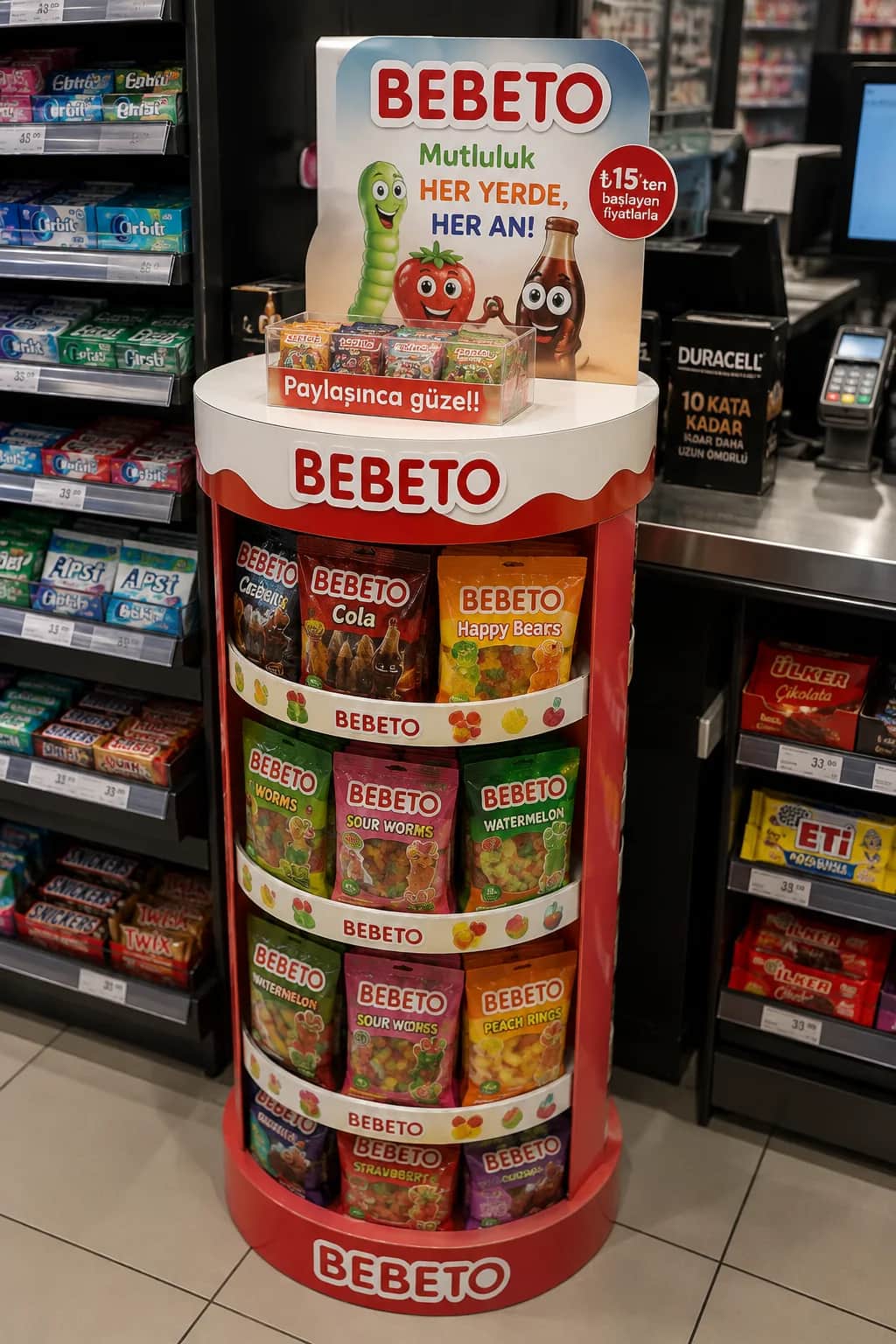
When a brand enters a store, it typically owns a facing of a few centimetres on its own shelf — at the same height, under the same light and at the same distance as ten competitors beside it. A display stand exists precisely to break that equality: it lifts the product out of its shelf, places it inside its own composition and creates a second touchpoint within the store.
This guide covers the plastic display stand end to end: what a stand is and how it differs from a shelf, which typologies exist, which materials serve which purpose, which questions decide the right stand, and what actually drives cost.
What is a plastic display stand?
A plastic display stand is a plastic structure that presents a product or product group at the point of sale, either standing on its own feet or attaching to an existing surface. What separates it from store furniture is that it is designed for a single brand or category: its dimensions follow that product’s packaging, its shelf angle follows that product’s weight, and its print area follows that brand’s communication.
The production method is most often plastic injection moulding. Melted granulate is injected under pressure into a steel mould, and the part is released once it cools. At high volumes this delivers a very low per-part cost and identical dimensions every time. At lower volumes, or for large-surface parts, vacuum forming and sheet bending take over. We covered every production step in detail in our display stand production process article.
A display stand is not designed to show a product. It is designed to raise the probability that the product is picked up. These are not the same thing.
How a display stand differs from a store shelf
A store shelf is neutral infrastructure; it offers the same conditions to every product in the category. A display stand is partisan, and that shows up in four places:
Location: A stand can be placed outside the category aisle, at the high-traffic points of the store. The product then meets shoppers who were not looking for its category at all.
Height and angle: A shelf is horizontal and fixed. Stand shelves can be angled forward; the product turns towards eye level, rear stock feeds forward and shelf gaps disappear.
Brand space: On a shelf, the only surface a brand controls is the packaging itself. A stand adds a header, side wings and front rails as extra communication area.
Capacity control: How many units a stand carries is decided at design stage. That decision also determines how often the store has to refill it.
Types of plastic display stand
Typology selection starts with where the stand will go. For the same product, a unit for an aisle entrance and a unit for the till point are two entirely different products.
Floor display units
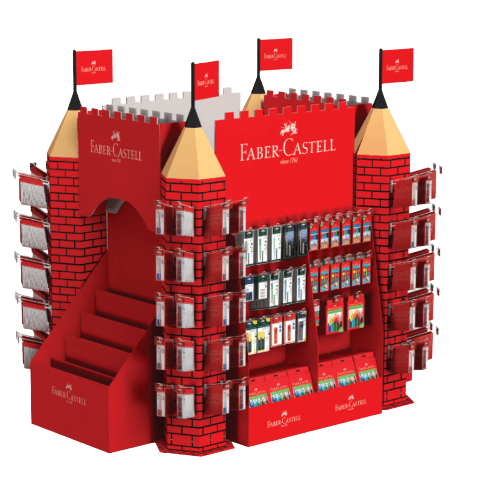
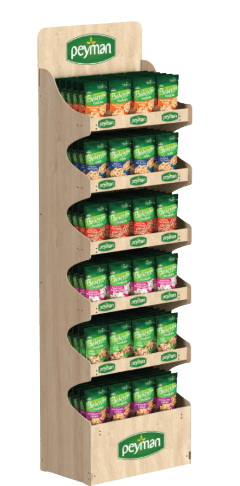
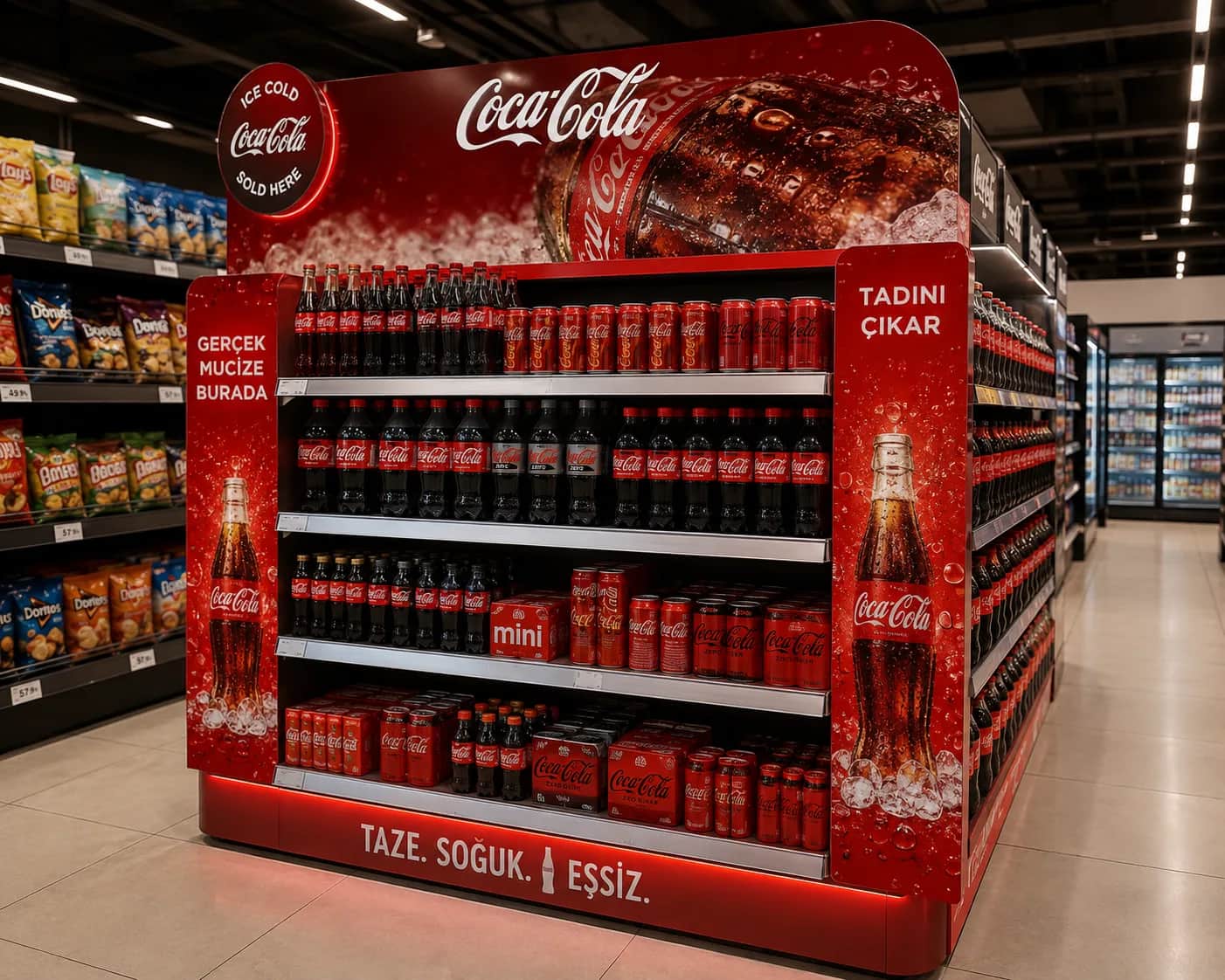
Units that stand alone in or at the entrance of an aisle, typically 1400–1800 mm tall. They carry four to six shelves and deliver the highest visibility inside a store. Because they need a load-bearing body they are usually injection moulded, with a ballast chamber added to the base. See our injection floor displays page for detail.
Countertop units
Compact stands in the 200–450 mm height range, designed for till points and service counters. They suit small, low-priced, impulse-decision products, and because counter space is expensive the footprint is kept as small as the product allows.
Bowl displays
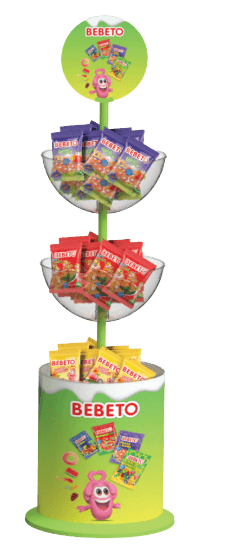
Open-top, bowl-shaped units for loose or bagged product. They keep the product visible from above, let shoppers reach in, and refill extremely fast. Preferred in confectionery, snacks and small-format packaging. You can review the models on our bowl display stands page.
Hang-on secondary units
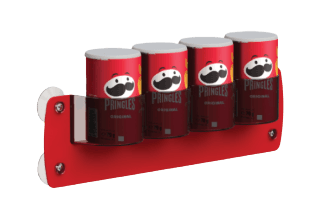
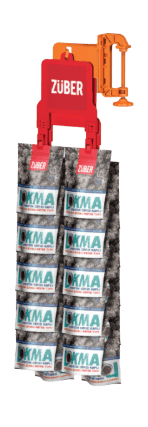
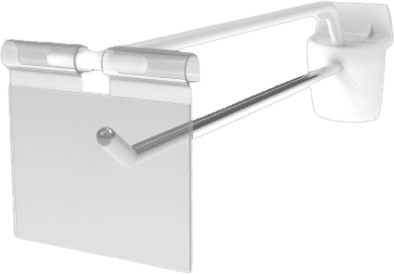
Secondary units with no feet of their own, attaching to a shelf edge, wire basket or hanging rail. Their biggest advantage is that they ask the store for no floor space, which makes them the easiest typology to get approved by store management. Our hang-on displays page covers usage examples.
Pallet surrounds and modular units
Frame systems dressed around a loaded pallet, plus modular shelf units that grow by connecting to each other. In high-volume promotions they let product be displayed straight off the pallet, sharply shortening the time from warehouse to shop floor.
Which materials are used?
Material determines lifespan before it determines looks. The table below compares the five polymers most commonly used in display stands; for a deeper analysis see our display stand materials article.
Material
Defining property
Typical use
Limit
PP (Polypropylene)
Flexes without cracking, allows living hinges
Floor stand bodies, shelves
Not transparent, scratches
ABS
High impact strength, good surface finish
Load-bearing connectors
Yellows under UV
PET / PETG
Transparent, food-safe, recyclable
Bowls and clear front barriers
Does not flex under load, cracks
PS / HIPS
Economical, easy to form
Short-run promotional units
Brittle, short service life
PMMA (Acrylic)
Glass-like clarity, premium look
Cosmetics and premium categories
Expensive, impact sensitive
Eight criteria for choosing the right stand
The answers to these eight questions define almost the entire design. We recommend filling this list in for your own project before requesting a quote.
1Product weight: The weight of a single unit and the total load per shelf set wall thickness and material.
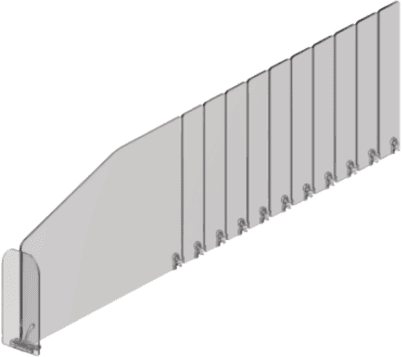
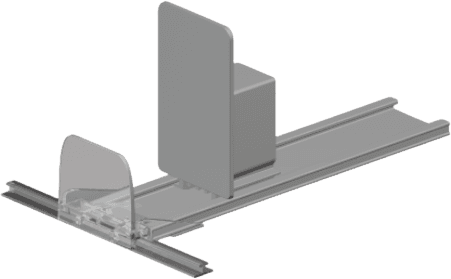
2Packaging form: Bottles, pouches, cartons and blisters do not want the same shelf depth. Packaging prone to tipping needs divider rails.
3Store format: Chain supermarkets, discounters, pharmacies and electronics retail all permit different footprints.
4Target volume: A 200-piece job and a 20,000-piece job do not use the same production method. Volume decides whether tooling investment makes sense.
5Service life: A six-week launch and a three-year category display call for different materials and different joining solutions.
6Shipping and storage: Whether the stand ships flat and is assembled in store, or ships assembled, sets box size and freight cost.
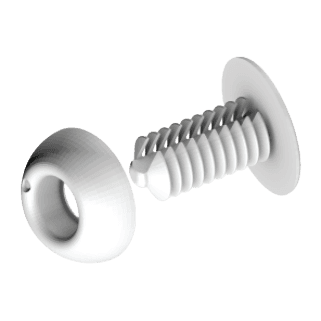
7Assembly: Does store staff need to build it without tools? That requirement forces snap-fit connections and screwless joints.
8Print requirement: Which print method will be used on the header, wings and front rails? That decision feeds back into the surface material.
Dimensions and load capacity
A stand is dimensioned around the product module, not around the gap in the store. Take the packaging width, decide how many units sit side by side, and build shelf width as a multiple of that number. The shelf then neither leaves a gap with half a product nor squeezes units against each other.
Typology
Typical footprint
Typical height
Load per shelf
Floor display
400 × 400 – 600 × 400 mm
1400 – 1800 mm
8 – 15 kg
Countertop unit
200 × 200 – 350 × 250 mm
200 – 450 mm
2 – 5 kg
Bowl display
250 – 450 mm diameter
150 – 300 mm
3 – 8 kg
Hang-on unit
60 – 120 mm width
300 – 900 mm
1 – 4 kg
Pallet surround
800 × 1200 mm (Euro pallet)
1200 – 1600 mm
Limited by pallet capacity
The figures above are typical ranges; final dimensions are always set from the product itself and the target store format.
Printing and brand dressing
There are four ways to carry brand communication onto a plastic surface, and each fits a different volume and lifespan scenario:
Screen printing: Applied directly to the plastic, extremely durable, and the most economical method at high volumes with a limited number of colours.
Digital UV printing: Delivers photographic, full-colour output and is advantageous at low volumes because it needs no screens.
Labels and film dressing: Can be changed for each campaign, allowing the same body to serve different brands.
Coloured raw material: Colouring the granulate itself instead of printing. Colour survives scratching, which makes it the choice for long-life stands.
What drives the cost?
The price of a display stand is not a single line item. Total cost splits into four headings: tooling investment, raw material, labour and logistics. Only tooling is one-off, and it is divided across the whole volume. That is why unit price falls sharply as volume grows. We walked through the calculation with a worked example in our injection mould cost article.
There are also cases where tooling investment makes no sense: for very low volumes, short lifespans and campaigns that must ship fast, a cardboard stand is the better answer. We compared both options in cardboard or plastic display.
Five common mistakes
Designing to the size of the gap instead of the size of the product. Unless the shelf is a multiple of the packaging, every shelf keeps dead space.
Ignoring refill ergonomics. A stand that store staff cannot refill stands empty within weeks.
Leaving the shipping carton to the end of the design. A stand that does not fit its box can double unit cost through freight alone.
Putting the header in front of the product. If the brand area blocks product visibility, the stand is not doing its job.
Approving on a single prototype. Testing the stand under real store conditions is the cheapest insurance available before the first production run.
In summary
Set up correctly, a plastic display stand is a tool whose return is as measurable as a packaging investment. Three variables sit at the centre of the decision: the physical reality of the product, the store location, and the volume of the project. Once those are clear, typology, material and production method follow almost by themselves.
Share
Q & A
Common questions
What is the core difference between a plastic and a cardboard display stand?
A plastic stand is a durable investment: it stays in store for years, carries high loads and is unaffected by humidity. A cardboard stand is produced for short campaigns, carries no tooling cost and ships far faster. The choice is usually made on service life and volume.
How long does it take to produce a display stand?
For standard models made from existing tooling, lead time is typically a few weeks. For designs that need project-specific tooling, mould manufacturing is the longest step and total time extends with part complexity. Exact timing is given per project once the brief is settled.
Is there a minimum order quantity?
Standard models with existing tooling can be run at low volumes. Designs that need a project-specific mould require a certain volume so the tooling cost can be spread across unit price; that threshold varies with part size and complexity.
Can we print our brand on the stand?
Yes. Headers, side wings and front rails are areas designed for brand communication. Screen printing, digital UV printing, label dressing or coloured raw material are selected according to volume and expected service life.
How is load capacity determined?
The total product weight per shelf is calculated, a safety margin is added, and wall thickness and material are selected against that figure. For heavy products, support ribs and carrier rails are added beneath the shelf.