
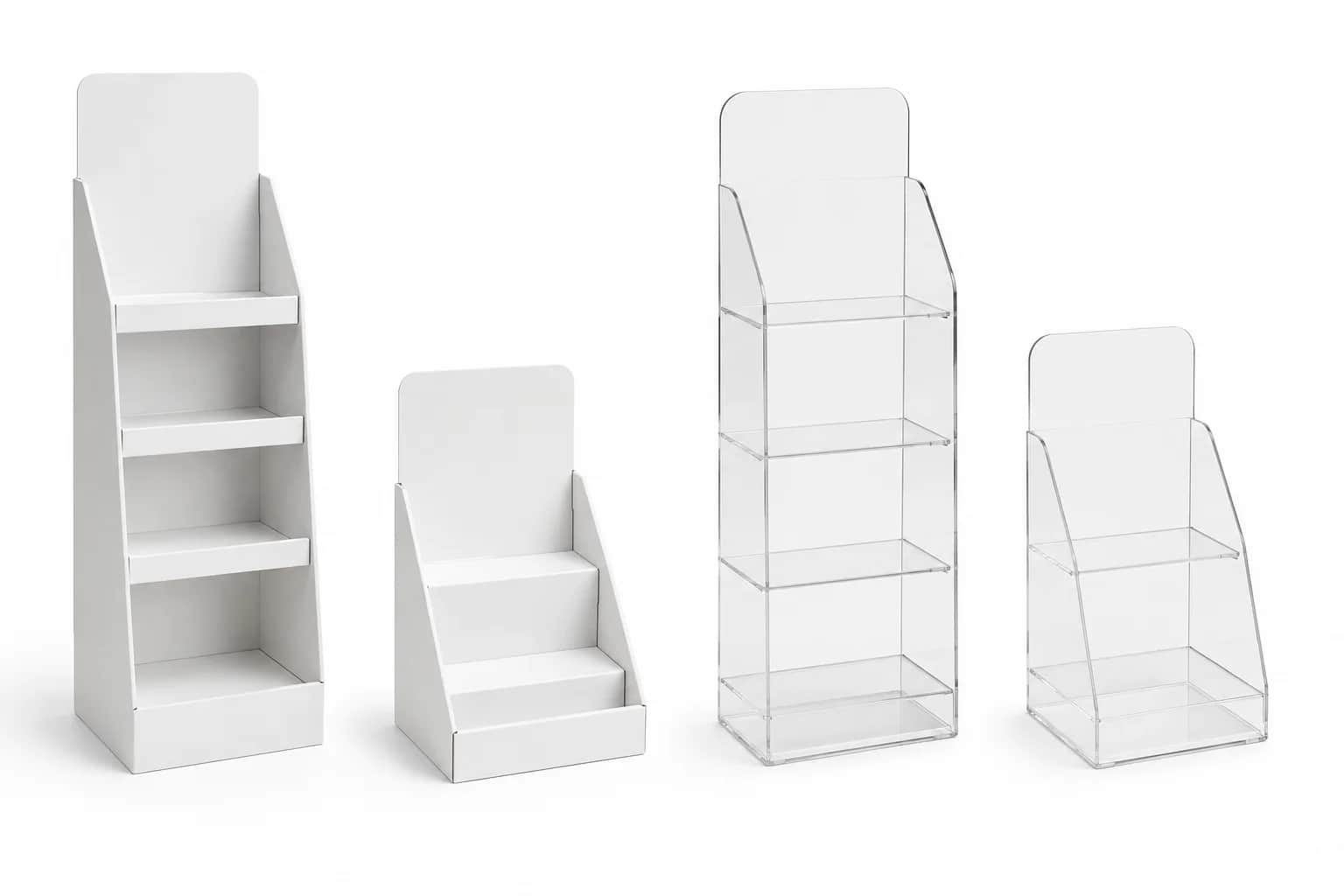
Materials8 min read
Cardboard or Plastic Display? Comparing Cost, Lifespan and Use
A six-week launch and a three-year category display do not want the same material. We compare both options on volume, duration, cost and logistics.
Read Article
Key takeaways
In display stand projects the material decision is usually left until last: the form is set, dimensions are settled, and only then does someone ask “which plastic should we use?”. Yet this is the question that determines how many months the stand survives in store, how many kilos it carries and how it looks a year later.
Below we take the five most common polymers in display stands one by one, explaining which is right under which conditions and which questions should steer the choice.
Material is a lifespan decision, not an aesthetic one. The wrong choice ends a good design within a single season.
The most widely used material in display stands. Its defining property is that it flexes rather than cracks: under impact it springs back instead of breaking. That behaviour answers the risk a stand meets most often in store — being knocked and dropped.
PP’s second major advantage is the living hinge. A thinned section turns into a hinge that can open and close thousands of times, removing the need for a separate part in folding lids and snap-fit joints.
An engineering plastic that combines high impact strength with good surface quality. It is more rigid than PP, meaning it does not bend under load — which makes it the right choice for load-bearing connectors and frames that need stiffness.
ABS surfaces take print and paint extremely well; it is the first material considered when a glossy, even finish is required. However it tends to yellow under UV: unmodified ABS will not look good for long in front of a window or in direct sunlight.
The material used where transparency is the priority. Because food-contact grades exist, it is preferred for loose product displays and bowl stands. PETG is the variant that forms more easily and resists cracking better than standard PET.
PET’s main limit is its behaviour under load: it stretches rather than flexes, and past a certain point it cracks. It therefore works well in clear front barriers and hoppers, but is not preferred for load-bearing body parts.
Polystyrene is an economical, easily formed material. Its impact-modified variant HIPS is widely used in short and medium-life display units. It suits thermoforming from sheet extremely well, which sharply lowers tooling cost at low volumes.
Its main limit is brittleness. For long-life, high-contact projects PP or ABS is the better choice. In a six-week campaign unit, however, PS is more than durable enough and its cost advantage is clear.
The plastic closest to the clarity of glass, and the standard material of premium categories. It is preferred in cosmetics, fragrance, watch and jewellery displays not only for transparency but for edge brilliance and light transmission: cut edges glow along with the light.
On the other hand it is expensive and impact-sensitive; it cracks when dropped. It should be used in protected window and counter areas rather than in high-contact store locations.
| Property | PP | ABS | PET / PETG | PS / HIPS | PMMA |
|---|---|---|---|---|---|
| Impact strength | Very good | Very good | Medium | Low | Low |
| Rigidity | Medium | High | High | Medium | High |
| Transparency | None | None | Very good | Limited | Excellent |
| UV resistance | Good (with additives) | Poor | Good | Poor | Very good |
| Surface / print | Needs pre-treatment | Very good | Good | Very good | Good |
| Cost | Low | Medium | Medium | Low | High |
| Recyclability | Very good | Medium | Very good | Medium | Limited |
| Condition | Recommended material | Reason |
|---|---|---|
| Cooler front, high humidity | PP | Unaffected by moisture, stays tough at low temperature |
| Heavy product, high shelf load | ABS or reinforced PP | Does not bend under load |
| Loose food display | PET / PETG | Food-safe grades, transparent, easy to clean |
| Six-week campaign | PS / HIPS or cardboard | Economical for a short lifespan |
| Premium showcase unit | PMMA | Edge brilliance and glass-like clarity |
| Outdoor, sunlit position | UV-stabilised PP or PMMA | Resistance to yellowing and embrittlement |
The sustainability discussion usually focuses on the material itself, whereas two other factors are decisive: the lifespan of the stand and whether it can be taken apart.
Modular design is part of this discussion too: a body with changeable dressing can be reused with a new brand at the end of a campaign instead of being discarded.
Material selection is a decision made where the physical reality of the stand meets the conditions of the store. PP and ABS answer load, PET and PMMA answer clarity, and PS answers short-life economy. The right answer is often not a single material but a hybrid construction that puts the right material in the right place. If you want to work out the right material for your project together, get in touch.
Polypropylene (PP) is the most common. Its flexibility means it springs back rather than breaking under impact, it is unaffected by moisture and it recycles easily. For load-bearing connectors, ABS is preferred for its rigidity.
PET or PETG is used for parts in food contact or needing moderate clarity. If glass-like clarity and edge brilliance are required, PMMA (acrylic) is preferred, though it is more expensive and more impact-sensitive.
No, and in most projects it is not. A common construction uses PP for body and shelves, ABS for load-bearing connectors and PET for the clear barrier. What matters is joining parts so they can still be separated for recycling.
Unmodified ABS and PS yellow and become brittle in sunlight. UV-stabilised PP or PMMA holds its appearance far longer under those conditions. For window fronts and outdoor placements this choice should be made from the start.
It can be used in many parts. The deciding factors are the load the part carries and the required surface quality; colour consistency should be checked on visible surfaces and mechanical strength on load-bearing parts. Parts in food contact require appropriately certified material.
Related solutions
Related equipment
Share your product, target store format and volume expectation; our technical team will propose the right solution.